
Blog · · 3 min read
Massage tables and beds: what the research says, and what makes a good one
Massage is one of the most requested services on any spa menu. Before choosing equipment it helps to separate what research supports from what is marketing, and then to see why the table itself matters more than most owners expect.
What the research says
According to the US National Center for Complementary and Integrative Health (NCCIH), the quality of massage research varies, the mechanisms are not well understood, and benefits for pain are mostly short term. The evidence is strongest where it is still modest:
- Low-back pain: weak evidence of benefit. A 2017 American College of Physicians guideline includes massage for acute or subacute low-back pain, but not for chronic low-back pain.
- Neck and shoulder pain: limited evidence of short-term relief.
- Fibromyalgia: some evidence that massage may help certain symptoms.
- Other conditions, such as headache or osteoarthritis: very limited or inconsistent evidence.
Many clients also book massage simply to relax, which is a perfectly good reason to offer it, but it is not a medical claim. Massage is not a substitute for medical care, and clients with medical conditions should check with their doctor first. This is why a spa should promise comfort and relaxation, and leave treatment claims to health professionals.
Why the table matters more than it seems
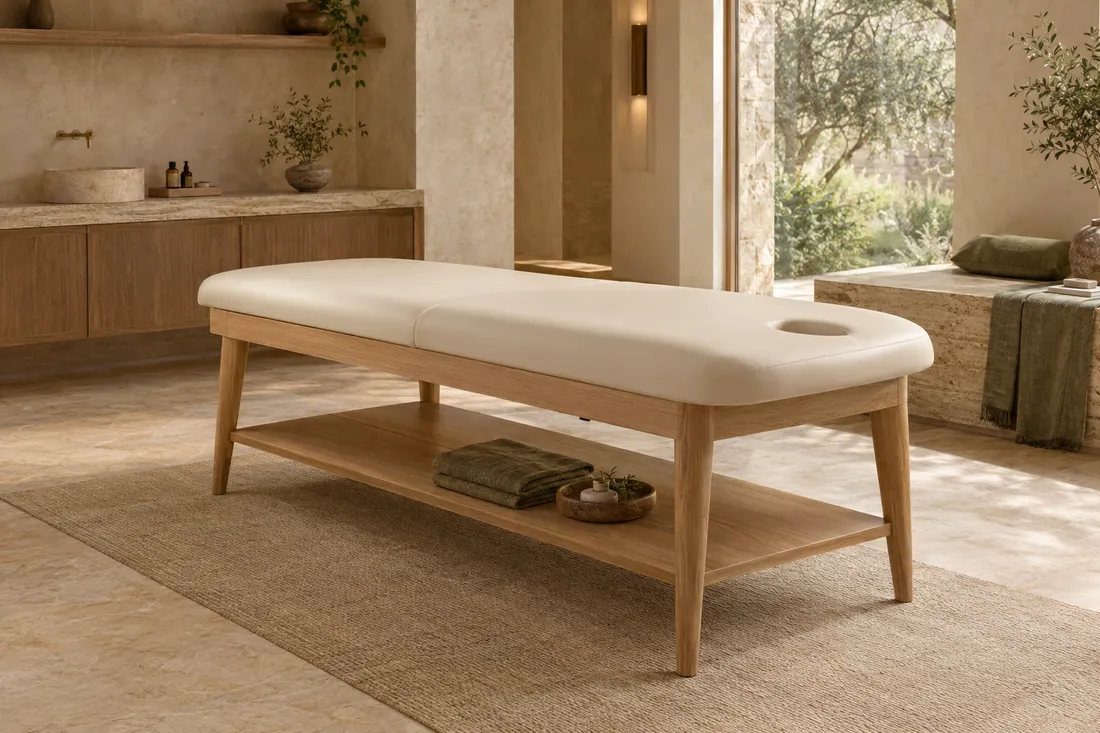
A client judges a massage through the table long before they judge the technique: how steady it feels, how it supports the body, whether the surface is warm and clean. The therapist also works on it all day, so the table shapes their posture and fatigue. Five things are worth checking:
- Stability. A table that does not creak or rock lets the therapist apply even pressure and lets the client relax. Solid wood construction and a fixed-height frame give the most rigid result.
- Working height. A fixed height suits spas where treatments are standardised. If several therapists of very different heights share one room, discuss this before ordering.
- Surface and upholstery. Seamless, wipe-clean upholstery makes hygiene between clients quick. The padding should be firm enough to support, soft enough to be comfortable for 60 to 90 minutes.
- Face opening and comfort details. A face hole lets the client lie face down without turning the neck; a heated top adds warmth, especially in cooler climates.
- Materials and look. Solid wood is durable and looks warm, and it can be matched to the rest of your room so the treatment space feels designed rather than assembled.
Choosing a table for your spa
Start with the room, not the catalogue. Measure the treatment room, decide how many therapists work in it and which treatments you offer, and think about how linen and products will be stored. Then choose size, wood and upholstery colour to match your interior.
Our Venus solid wood spa massage table is built around these points: a solid wood frame, fixed height, 200 x 80 cm top, an optional heated top, and wood and upholstery made to match the rest of the furniture. If you are furnishing a whole spa, see our turnkey projects, where the tables, cabinets and partitions are produced together in one workshop.
Sources
Free layout
Planning a spa or treatment rooms?
PDF, DWG or a phone photo of a sketch — all fine. Replies within 24 hours.